Čeština
 Deutsch


Inmortal Samurai Katana with Dragon-Motif Guard
3x


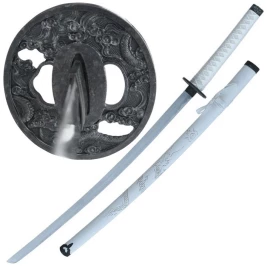
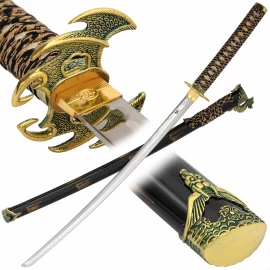
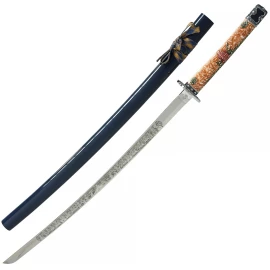
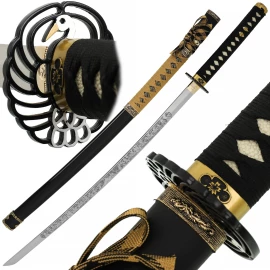
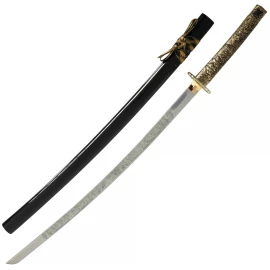
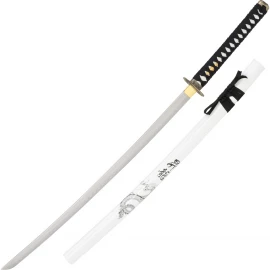
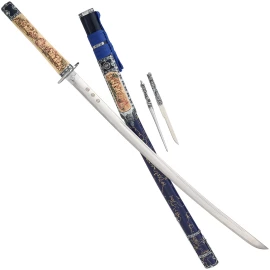
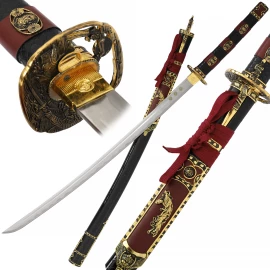
Discover the captivating beauty of Japanese samurai swords in an extraordinary design! The Inmortal decorative katana by Spanish manufacturer MARTO features an elaborately decorated ivory-coloured grip and a bronze-coloured guard adorned with dragon and mythical bird motifs. Intricate raised reliefs, ornamental patterns and a long polished blade combine to create a striking sword that will stand out in any historical weapons collection. An elegant black scabbard with a glossy finish completes the appearance. Manufactured in the famous Spanish sword-making city of Toledo, this collectible samurai sword makes an impressive display piece for enthusiasts of Japanese history, samurai culture and East Asian art. Further product information ...

Would you like to be notified as soon as the item is in stock?
You will receive a short e-mail as soon as we have it back in stock.
Inmortal Decorative Samurai Katana with Dragon-Motif Guard
An Elaborately Decorated Katana with a Distinctive Guard
Unlike conventional samurai swords with fabric-wrapped grips, the Inmortal katana features a particularly elaborate decorative hilt. Its pale grip with darkened raised details contrasts beautifully with the bronze-coloured guard, polished steel blade and black scabbard.
- Blade (nagasa): The long, slightly curved blade is made from AISI 420 stainless steel. It features a polished surface, single-edged geometry and a characteristic angled point (kissaki). Its shape draws inspiration from traditional Japanese sword blades.
- Grip (tsuka): The grip is made from resin with an ivory-effect finish. Its entire length is decorated with finely detailed raised reliefs depicting human figures, ornamental bands, floral patterns and other scenes inspired by East Asian decorative art. Darkened recesses emphasise the intricate details.
- Pommel cap (kashira): The widened, sculpted end of the grip features scale-like patterns, stylised animal motifs and flowing ornamental lines.
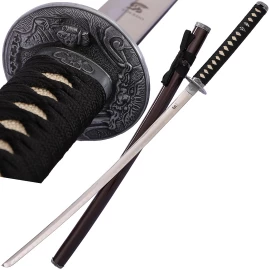
- Guard (tsuba): The circular, richly detailed openwork guard has a bronze-to-copper-coloured finish with dark patination in the recesses. Its most distinctive feature is the intertwined depiction of a dragon and a mythical phoenix-like bird. The intricate reliefs reveal scales, feathers, wings and long, flowing sections of the creatures' bodies.
- Grip collar (fuchi): The darker metal collar between the grip and the guard is decorated with fine raised ornamental designs.
- Blade collar (habaki): The copper-coloured fitting at the base of the blade features a longitudinally grooved edge and a decorative circular emblem. It helps secure the blade within the mouth of the scabbard.
- Scabbard (saya): Made from black lacquered aluminium with a smooth, glossy finish, the scabbard features a black cord near its opening, reminiscent of the traditional Japanese securing cord known as sageo.
The decorated grip deserves particular attention. Rather than the conventional combination of rayskin and cord wrapping, this model features continuous sculpted ornamentation, making the hilt one of the sword's most distinctive artistic elements.
Dragon and Phoenix – Symbols of East Asian Tradition
The guard features two mythical creatures whose forms resemble a dragon and a phoenix. Both motifs have a long history in East Asian decorative arts.
In East Asian cultures, the dragon has traditionally been associated with power, authority, natural forces and protection. The mythical bird known in Japan as the hōō, related to the Chinese fenghuang, symbolised noble qualities and auspicious signs. Its symbolism differs from the European concept of the phoenix rising from its own ashes.
Dragons and mythical birds appeared on many Japanese artistic and decorative objects, including ornamental sword fittings. On the Inmortal katana, these figures represent an artistic interpretation of traditional motifs rather than a documented reproduction of a particular historical sword guard.
The History of the Katana – From Battlefield Sword to Samurai Symbol
The katana is a traditional Japanese sword characterised by a single-edged, generally slightly curved blade and a grip long enough for two-handed use. Its development evolved from earlier forms of Japanese swords.
The katana became increasingly widespread during the Muromachi period (1336–1573), particularly in its later centuries. Unlike the older tachi, which was generally suspended with the cutting edge facing downwards, the katana was normally worn through the sash (obi) with its cutting edge facing upwards. This arrangement enabled the sword to be drawn quickly and brought directly into a cutting movement.
During the Edo period (1603–1868), the katana became an important symbol of samurai social standing. Together with the shorter wakizashi, it formed the two-sword combination known as the daishō. The right to wear this pair of swords was closely associated with membership of the samurai class.
Interestingly, swords were by no means the only weapons employed by Japanese samurai. On the battlefield, they also used bows, yari spears, naginata polearms and, from the 16th century onwards, firearms. Nevertheless, the katana gradually became one of the most recognisable symbols of their social identity.
The Inmortal katana is not an exact reproduction of any particular surviving historical sword. It is an artistically styled decorative piece that combines the traditional form of a Japanese katana with elaborate ornamental decoration.
What Does the Name Inmortal Mean?
Inmortal is Spanish for 'immortal'. This name reflects the character of a collector's sword inspired by Japanese traditions whose artistic and craft heritage has endured for centuries.
The name also complements the mythical creatures featured on the sword guard. However, it is not the historically documented name of a specific samurai weapon, but the commercial model name of this decorative sword.
A Collectible Samurai Sword from Toledo
The Inmortal katana belongs to the exclusive Oriental Weapons collection produced by the Spanish manufacturer MARTO.
The Spanish city of Toledo has been famous for its sword-making heritage for centuries. Today, the city also produces decorative swords inspired by European and non-European historical traditions. This model therefore combines Japanese artistic inspiration with the Spanish tradition of manufacturing collectible swords.
We particularly recommend this katana for:
- displaying in a collection of samurai swords and historically inspired bladed weapons,
- decorating a study, library or living room,
- complementing a collection of Japanese art and East Asian decorative objects,
- themed exhibitions devoted to Japanese warriors and their culture,
- static photographic arrangements or exhibition displays,
- an original gift for an enthusiast of Japan, samurai culture and historical swords.
The sword is supplied with a black scabbard and a Certificate of Quality and Origin, confirming its manufacture in Toledo, Spain.
Technical Specifications of the Inmortal Katana
| Specification | Details |
|---|---|
| Product type | Decorative samurai katana |
| Model | Inmortal |
| Historical inspiration | Japanese katanas, particularly 15th–19th centuries |
| Overall length | Approx. 103.5 cm (40.7 in) |
| Blade length | Approx. 69.5 cm (27.4 in) |
| Guard diameter (tsuba) | Approx. 7.5 cm (3.0 in) |
| Weight without scabbard | Approx. 1,250 g (2.76 lb) |
| Blade material | AISI 420 / X30Cr13 stainless steel |
| Blade hardness | 48–52 HRC |
| Blade design | Slightly curved, single-edged, polished finish |
| Grip material | Ivory-effect resin |
| Grip decoration | Raised figurative, floral and ornamental reliefs |
| Guard (tsuba) | Circular openwork metal guard |
| Guard motifs | Dragon and mythical phoenix-like bird |
| Guard colour | Bronze-to-copper finish with dark patination |
| Scabbard material (saya) | Lacquered aluminium |
| Scabbard colour | Glossy black |
| Intended use | Decorative and collectible purposes only |
| Manufacturer | MARTO |
| Collection | Oriental Weapons |
| Place of manufacture | Toledo, Spain |
| Certificate | Certificate of Quality and Origin |
Important Safety Information
Important: This katana is strictly a decorative sword and is not intended for practical use! Although its stainless-steel blade has a stated hardness of 48–52 HRC, its construction is not designed to withstand the mechanical stresses associated with practical fencing or cutting.
- Not suitable for contact fencing: Never use this sword for duelling, sparring, contact stage combat or training involving strikes against another weapon.
- Do not attempt test cutting: The katana is not intended for tameshigiri or cutting tatami mats, bamboo, bottles or other objects. Impact may damage or fracture the blade and cause injury.
- Not suitable for practical iaidō training: Use a purpose-made training sword for repeated drawing exercises and sword techniques.
- Beware of the point and cutting edge: Even a decorative sword can cause deep cuts. Careless handling may result in serious or potentially fatal injuries.
- Protect the grip: The sculpted resin material may crack or chip if dropped or subjected to a severe impact.
- Safe storage: Keep the katana inside its scabbard, on a stable sword stand or in a locked display cabinet, out of the reach of children. All handling is undertaken at your own risk.
How to Care for Your Inmortal Katana
Thanks to its stainless-steel blade and aluminium scabbard, this decorative sword is relatively straightforward to maintain. However, we recommend following these guidelines to preserve its appearance:
- After handling, wipe the blade with a soft, dry cloth to remove fingerprints, perspiration and moisture.
- For long-term storage, you may apply a thin layer of suitable protective oil to the blade.
- Avoid abrasive sponges, aggressive cleaning products and polishing compounds that could damage the blade's surface.
- Clean the sculpted grip carefully using a soft brush or dry cloth. Avoid harsh solvents and prolonged exposure to water.
- Wipe the bronze-coloured guard gently without using abrasive cleaners, which could damage its decorative finish.
- Protect the black lacquered scabbard from scratches and impacts.
- Store the katana in a dry environment, away from direct sunlight and significant temperature fluctuations.
Recommended Accessories
For safe and attractive display, we recommend a horizontal Japanese sword stand (katana-kake). Comparable sword stands were also used in Japanese households during the Edo period (17th–19th centuries).
If you would like to expand your collection, consider pairing the katana with a shorter wakizashi sword or a tantō dagger, inspired by Japanese weapons of the 16th–19th centuries. For safely practising basic Japanese sword movements, we recommend a separate wooden training sword (bokken) rather than this decorative model.
We are here for you!