Čeština
 Deutsch


Lowlander – Scottish Mercenary Great Sword of the 16th Century


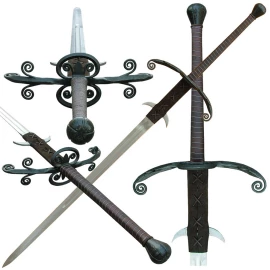
The monumental Scottish Lowlander great sword makes an ordinary longsword look almost compact. Measuring approximately 68.5 in (174 cm) overall, with a blade around 48 in (122 cm) long and an exceptionally extended two-handed grip, it draws inspiration from the huge swords of the 16th century. The broad 1566 steel blade carries a distinctive antiqued finish, whilst the blackened ring guard and studded black leather grip create an unmistakable silhouette. Despite its enormous dimensions, this is proportioned as a functional weapon rather than an enlarged decorative sword. We particularly recommend it to experienced collectors, re-enactors and enthusiasts of Scottish military history. Further product information ...

Would you like to be notified as soon as the item is in stock?
You will receive a short e-mail as soon as we have it back in stock.
Lowlander – Scottish Mercenary Great Sword of the 16th Century
A monumental two-handed sword with Scottish Lowland character
The historical inspiration for this model comes from the great two-handed swords of the 16th century, weapons found in Scotland as well as elsewhere in Europe. The Lowlander differs substantially from the better-known Highland Claymore. Whereas the classic Claymore generally has a comparatively simple crossguard sloping towards the blade, this form uses much more elaborate hand protection with very long quillons, side rings and recognisably Scottish decorative details.
Great swords of this kind belong to a period in which pikes, firearms and increasingly professional mercenary forces were changing European battlefields. Their exceptional reach allowed powerful sweeping cuts with tremendous momentum. Handling a weapon approaching 6 ft in length nevertheless required experience, strength, sound body mechanics and, above all, plenty of room.
Large swords of this general family are sometimes described in English-language collecting literature as slaughter swords. Typologically, however, the Lowlander is best understood as a Scottish interpretation of the 16th-century great sword or two-handed sword.
Massive 1566 steel blade
The straight, double-edged blade measures approximately 48 in (122 cm) and is made from 1566 high-carbon manganese steel. At the guard it is around 2.3 in (5.8 cm) wide and approximately 0.32 in (8 mm) thick. Towards the point it narrows to approximately 1.19 in (3 cm) in width and 0.22 in (5.6 mm) in thickness. These are substantial proportions appropriate to a blade that must cope with the considerable forces generated by a sword of this size.
A pronounced fuller runs along part of the blade, distributing material whilst reducing unnecessary mass. The surface carries a deliberately irregular antiqued finish. Its mottled appearance is therefore part of the intended aged character rather than a manufacturing defect.
The blade is functional and sharpened. Its point of balance lies approximately 9 in (22.9 cm) ahead of the guard, giving the weapon considerable forward presence. A Lowlander of this size is never intended to handle like a lightweight HEMA feder or ordinary longsword: its character lies in exceptional reach, mass and momentum.
Scottish ring guard with quatrefoil detail
The hilt is one of the most distinctive features of this Scottish great sword. Its blackened steel quillons are exceptionally long and sweep towards the blade before curving back at their ends. Drop-shaped terminals complete them, whilst large side rings add additional protection around the hands.
Within one of the rings is a characteristic quatrefoil, reinforcing the Scottish identity of the design. Short langets, meaning metal projections extending along the base of the blade, visually connect the guard and blade.
Extra-long leather grip for two-handed control
The hilt measures approximately 21 in (53.3 cm), allowing an unusually wide distance between the hands and therefore tremendous leverage. The wooden grip core is covered in black leather and reinforced by an additional criss-cross leather binding. Small studs secure the overwrap and create the characteristic appearance visible in the historical-style design.
A large rounded pommel with a blackened finish completes the hilt. The termination of the blade tang remains visible at its centre. The pommel acts as a counterweight, although the enormous blade means the point of balance intentionally remains well forward of the crossguard.
Antiqued character rather than a mirror polish
This version of the Lowlander is particularly suitable if you prefer a sword that does not look freshly mirror-polished. The blade has an aged antiqued finish whilst the guard and pommel are blackened. The result suggests a weapon with history and character straight from the box.
Do not attack the antiqued surfaces with abrasive polishing compounds, steel wool or aggressive cleaners. Doing so can remove the intentional finish as well as dirt.
Technical specifications
| Specification | Value |
|---|---|
| Weapon type | Scottish great sword, two-handed sword, Lowlander sword |
| Historical period | 16th century |
| Blade material | 1566 high-carbon manganese steel |
| Finish | antiqued blade, blackened hilt |
| Overall length | approx. 68.5 in (174 cm) |
| Blade length | approx. 48 in (122 cm) |
| Hilt length | approx. 21 in (53.3 cm) |
| Blade width at guard | approx. 2.3 in (5.8 cm) |
| Blade width near point | approx. 1.19 in (3 cm) |
| Blade thickness at guard | approx. 0.32 in (8 mm) |
| Blade thickness near point | approx. 0.22 in (5.6 mm) |
| Point of balance | approx. 9 in (22.9 cm) ahead of the guard |
| Point of harmonics | approx. 30 in (76.2 cm) from the guard |
| Weight | approx. 6 lb 14 oz to 7 lb 11 oz (3.1 to 3.5 kg), depending on production series |
| Blade edge | sharp and sharpened, category up to 0.02 in (0.5 mm) |
| Blade point | sharp and pointed |
| Grip | wooden core, black leather, studded criss-cross leather binding |
| Guard | blackened steel with side rings |
| Scabbard | not included |
| Wall mount | not included |
| Assembly | some assembly may be required |
Manufacturer specifications from different production runs give slightly different weights, so we state an approximate range. As the final stages of manufacture are completed by hand, all dimensions, weight and balance figures should be regarded as approximate, and the individual sword supplied may vary slightly.
Scottish Lowlands, mercenaries and 16th-century warfare
The name Lowlander refers to the Scottish Lowlands, a region with a cultural and military environment distinct in many ways from the Highlands. Scottish soldiers and mercenaries had a long tradition of service both at home and abroad during the 16th century. Huge two-handed swords became some of the most visually impressive weapons associated with professional infantry of this era.
According to the manufacturer, this design is based upon a surviving museum piece. It should not, however, simply be treated as another Highland Claymore. Its extensive side rings, exceptionally long grip and overall proportions place it closer to the monumental great swords of the 16th century, whilst unmistakably Scottish details preserve its particular identity.
Care and safe use
1566 carbon steel is not stainless. After handling or use, wipe the blade with a clean, dry, soft cloth and apply a very thin coating of suitable sword oil or conservation wax. Fingerprints contain salts and acids that can encourage corrosion surprisingly quickly. Do not clean the antiqued finish with abrasive polishing compounds, steel wool or sandpaper.
- The Lowlander is not a HEMA trainer and is not intended for blade-to-blade stage combat.
- Never use the sharp blade against another steel weapon.
- At approximately 68.5 in (174 cm) long, the sword requires an exceptionally large clear safety area in every direction.
- Before moving the sword, make sure no people, animals, furniture, ceilings or other obstacles are within its arc.
- Do not strike trees, hard timber, stone, metal or other unsuitable hard targets.
- For controlled test cutting, use only appropriate soft targets and sound cutting technique.
- Inspect the blade, guard, grip and pommel for damage or looseness before every use.
- Do not attempt to wield this sword one-handed because of its mass and momentum.
- Store it dry, securely supported and away from children and unauthorised persons.
Recommended accessories
- Heavy-duty wall mount or great-sword stand – modern equipment for safely supporting a weapon almost 6 ft long.
- Sword oil or conservation wax – modern essential equipment for maintaining the carbon-steel blade.
- Leather gloves – suitable for 16th-century historical presentation and more secure handling.
- Renaissance doublet – a useful basis for a 16th-century impression.
- Woollen hose and period shirt – suitable for civilian or military 16th-century clothing.
- Mail shirt or elements of plate armour – depending on the chosen soldier, appropriate to 16th-century military equipment.
- Wool cloak – a useful addition to a Scottish-inspired 16th-century impression.
Kingston Arms – functional historical swords built for performance
Kingston Arms is a premium brand of the American company CAS Iberia, established in 2016. Its range concentrates on functional European edged weapons, from medieval swords and Renaissance arms to specialist training weapons for HEMA and historical re-enactment.
Selected Kingston Arms ranges have been developed with renowned sword designer Angus Trim, whose work is particularly valued for harmonious mass distribution and dynamic handling. Elsewhere in the range you will find resilient 9260 spring steel hardened to approximately 50 HRC, the King-Peen hilt-retention system and more traditionally constructed swords using other high-quality carbon steels.
The Lowlander uses 1566 steel and represents the monumental end of the range: this is a genuinely enormous two-handed sword rather than an enlarged decorative piece. Kingston Arms therefore bridges the gap between relatively affordable production swords and considerably more expensive custom work. For collectors and re-enactors, the Lowlander combines functional construction, strong historical character and truly spectacular proportions.
We are here for you!