Čeština
 Deutsch


Sharp Scottish Single-Hand Sword, 15th Century


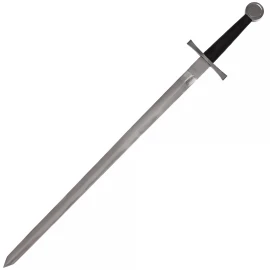
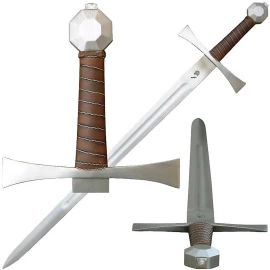
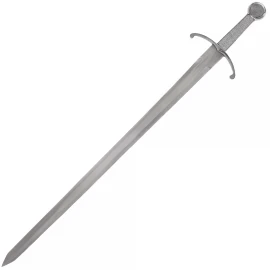
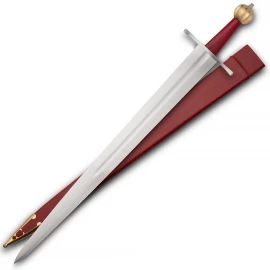
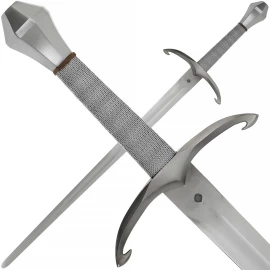
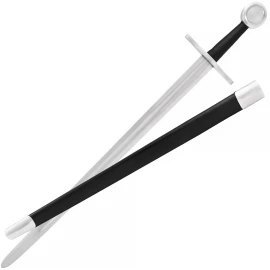
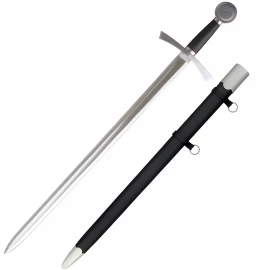
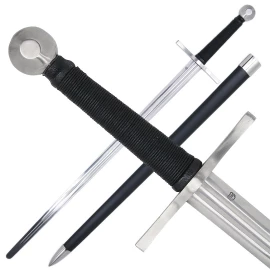
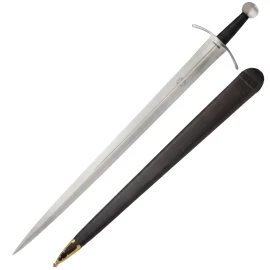
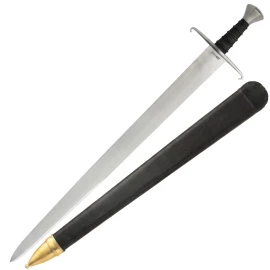
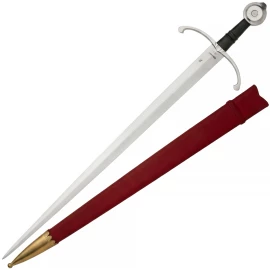
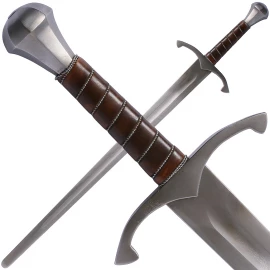
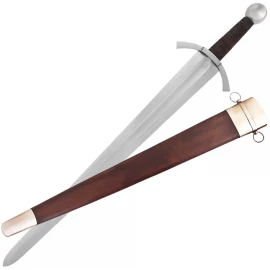
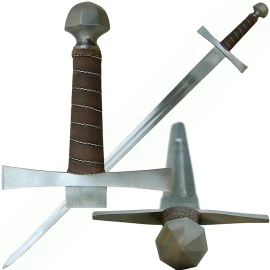
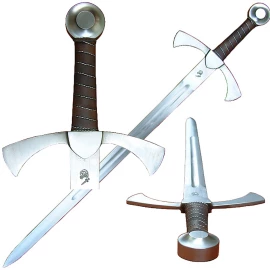
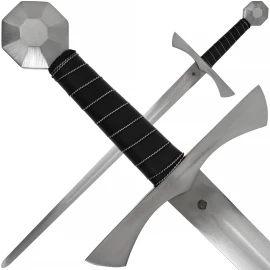
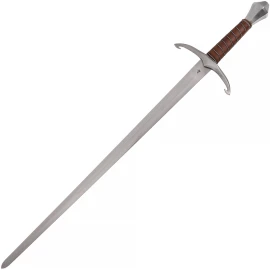
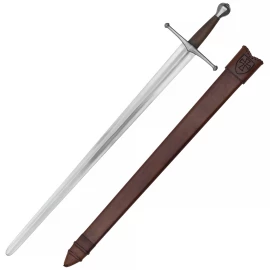
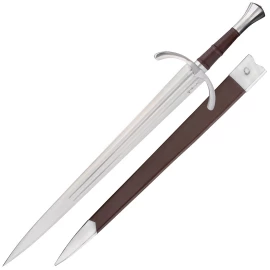
If you want a sharp Scottish sword based on genuine late medieval weapons rather than a romanticised image of later Highland warriors, this model deserves your attention. Its slender double-edged carbon-steel blade, downward-sloping guard, short langet, leather grip and distinctive wheel pommel draw upon swords associated with the western Highlands and Western Isles during the 15th century. At only about 822 g / 1 lb 13 oz, it is remarkably light and lively for a functional steel sword. A black leather-covered wooden scabbard with steel fittings is also included. Further product information ...

Would you like to be notified as soon as the item is in stock?
You will receive a short e-mail as soon as we have it back in stock.
Donald Balloch Sharp Scottish Single-Hand Sword, 15th Century
A Sword of the Western Highlands and Isles
This model is inspired by Scottish single-handed swords of the 15th century, particularly weapons associated with the western Highlands and Western Isles. This was the world of the Hebrides, Argyll and Scotland's western seaboard, an area shaped by Gaelic culture, maritime connections and the legacy of the earlier Norse-Gaelic world.
Our knowledge of these weapons comes not only from surviving swords but also from the remarkable West Highland grave slabs found throughout western Scotland. Medieval carvings repeatedly depict swords with downward-sloping quillons, distinctive pommels and short projections extending from the guard along the blade. During the 15th century, wheel pommels increasingly appeared alongside older lobed forms, as represented on this particular sword.
These one-handed weapons represent an important stage in the development of the Scottish Highland sword. Much larger two-handed swords, now commonly associated with the term claymore, became increasingly prominent around the end of the 15th and during the 16th century. This model belongs to the earlier tradition: it is a compact late medieval single-handed fighting sword rather than a miniature two-handed claymore.
Light Double-Edged Cut-and-Thrust Blade
The straight double-edged blade is made from high-carbon steel and measures approximately 78.1 cm / 30.75 in. The manufacturer does not specify the precise steel grade for this particular model. At the guard the blade is approximately 3.3 cm / 1.3 in wide and 5.6 mm / 0.22 in thick, reducing to roughly 2.8 mm / 0.11 in near the point.
A shallow fuller runs along a substantial portion of the blade. A fuller is a longitudinal recess that influences the distribution of material through the blade whilst also forming a characteristic feature of many historical swords. The blade tapers smoothly towards a pronounced point, retaining effective cutting geometry whilst also supporting accurate thrusting.
The point of balance lies approximately 12.7 cm / 5 in ahead of the guard. Combined with a weight of only about 822 g / 1 lb 13 oz, this gives the sword quick and lively handling. There is still enough blade presence ahead of the hand to make cuts authoritative without turning the weapon into an unnecessarily cumbersome one-hander.
Down-Sloping Guard with Short Langet
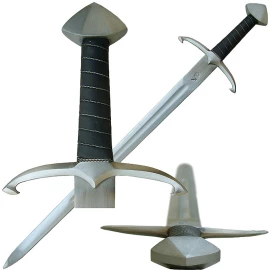
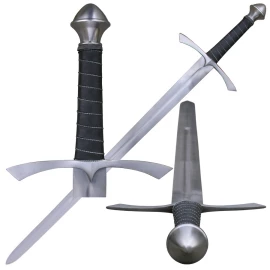
One of the most distinctive features is the short guard with downward-sloping quillons. Both arms angle noticeably towards the blade and terminate in smoothly rounded ends. This profile immediately distinguishes the sword from the simple straight crossguard familiar from many Continental medieval swords and is strongly associated with late medieval Scottish hilt forms.
A short langet projects from the centre of the guard along the blade. Langets helped stabilise the relationship between sword and scabbard mouth whilst providing another structural and visual link between blade and hilt. Both the guard and pommel have a restrained matt stainless-steel finish.
Leather Grip and Peened Wheel Pommel
The grip has a wooden core covered in black leather. Its straightforward oval profile suits the functional character of the sword and provides a secure surface without excessive decoration. The listed handle length is approximately 14.9 cm / 5.88 in.
A broad wheel pommel completes the hilt. The blade tang is traditionally peened over the pommel, mechanically securing the hilt in a manner characteristic of medieval European sword construction. The bright circular pommel also provides a strong visual contrast with the understated black leather grip.
Leather-Covered Scabbard Included
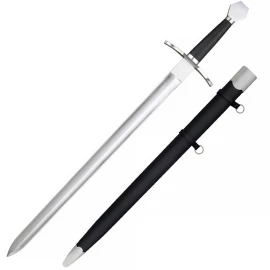
The sword is supplied with a wooden scabbard covered in black leather. A broad steel throat at the mouth is shaped to accommodate the sword's short langet, whilst a metal chape protects the lower end. The simple combination of black leather and bright steel makes the scabbard easy to integrate with an appropriate late medieval sword belt and suspension.
Scottish Single-Hand Sword Specifications
| Specification | Details |
|---|---|
| Historical inspiration | western Scotland and Western Isles, 15th century |
| Type | Scottish single-hand sword, Highland sword, medieval arming sword |
| Blade material | high-carbon steel |
| Blade | straight, double-edged, with fuller |
| Overall length | approx. 94.6 cm / 37.25 in |
| Blade length | approx. 78.1 cm / 30.75 in |
| Handle length | approx. 14.9 cm / 5.88 in |
| Blade width at guard | approx. 3.3 cm / 1.3 in |
| Blade thickness at guard | approx. 5.6 mm / 0.22 in |
| Blade thickness near point | approx. 2.8 mm / 0.11 in |
| Point of balance | approx. 12.7 cm / 5 in ahead of the guard |
| Weight | approx. 822 g / 1 lb 13 oz |
| Grip core | wood |
| Grip covering | black leather |
| Guard | matt stainless steel with sloping quillons and short langet |
| Pommel | matt stainless-steel wheel pommel |
| Pommel construction | traditionally peened to the blade tang |
| Blade point | sharp and pointed |
| Blade edge | sharp, category up to 0.5 mm / 0.02 in |
| Scabbard | wooden core, black leather covering and steel fittings |
| Suitable for | collecting, historical interpretation and controlled test cutting by experienced users |
| Contact fencing | not suitable for HEMA sparring, contact reenactment or stage combat |
Because the sword receives a degree of manual finishing, the listed dimensions, weight and other specifications should be regarded as approximate. Individual examples may vary slightly.
Donald Balloch and the Power of the Lords of the Isles
Donald Balloch MacDonald was a 15th-century Gaelic lord, Lord of Dunyvaig and the Glens and an important figure within Clan Donald. His career belonged to the political world of the Lordship of the Isles, whose power extended across large parts of the western Highlands and Hebrides.
In 1431 Donald Balloch led the forces of the Isles at the Battle of Inverlochy against a Scottish royal army. The forces of the Lordship achieved a major victory there. Balloch is therefore a comparatively little-known but fascinating warrior from precisely the region and century associated with this type of sword. We have chosen his name for this model in his honour. It is not a reconstruction of Donald Balloch's personal sword.
Care and Safe Handling
High-carbon steel is not stainless. After handling the sword, wipe the blade with a clean, soft and dry cloth to remove perspiration, fingerprints and moisture, then apply a very thin film of suitable sword oil. Pay particular attention to the junction around the guard and langet, where moisture can remain unnoticed. The stainless-steel fittings require less maintenance but should still be kept clean and dry.
The leather grip and leather-covered scabbard may occasionally be treated sparingly with a conditioner intended for natural leather. Do not store the sword for prolonged periods in a damp scabbard. If either becomes wet, allow the sword and scabbard to dry separately before storage.
This is a sharp functional sword. Never use it for HEMA sparring, contact reenactment or stage fighting with a partner. Do not strike metal, stone, trees, hard timber or another sword blade. Restrict test cutting to suitable targets within a sufficiently large and controlled safety area, and inspect the hilt and cutting edges regularly for damage.
Recommended Accessories
- Leather sword belt and suspension based on 15th-century examples for carrying the included scabbard appropriately.
- Padded aketon or gambeson based on 14th and 15th-century examples for a late medieval Scottish warrior impression.
- Mail coif or mail armour inspired by 14th to 15th-century equipment for a more complete historical presentation.
- Leather gloves based on 15th-century examples as a practical addition to a historical outfit.
- Blunt single-handed training sword for HEMA partner practice and contact historical fencing.
- Blade oil and a soft cotton cloth as modern essentials for routine carbon-steel maintenance.
Kingston Arms – Functional Historical Swords
Kingston Arms is a premium brand of the American company CAS Iberia, established in 2016. It specialises in functional and historically inspired European edged weapons, ranging from early medieval and knightly swords to Renaissance rapiers and purpose-built HEMA training weapons.
Selected Kingston Arms ranges benefit from collaboration with respected sword designer Angus Trim and employ features such as 9260 spring steel or the King-Peen system. This particular Scottish single-hand sword instead uses a traditionally conceived construction with a high-carbon steel blade, wooden grip core, leather covering and peened wheel pommel. Kingston Arms therefore offers an attractive bridge between affordable production swords and considerably more expensive bespoke sword making.
We are here for you!