Čeština
 Deutsch


Peter von Danzig HEMA Training Longsword


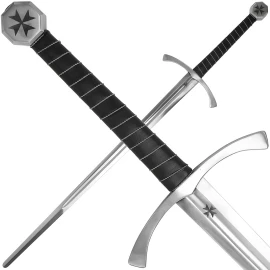
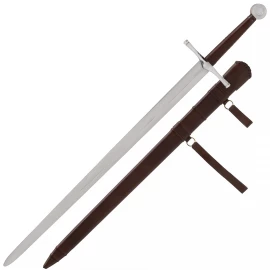
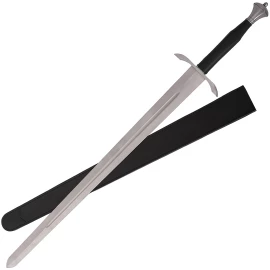
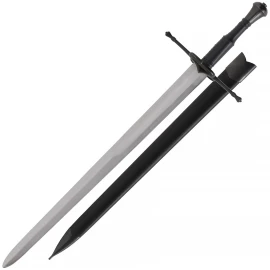
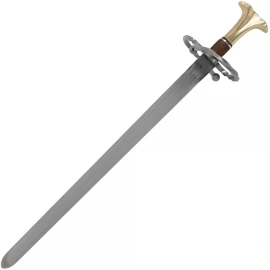
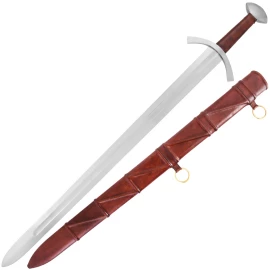
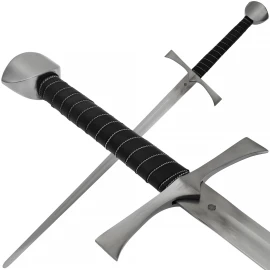
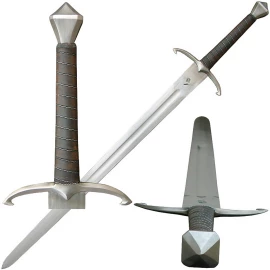
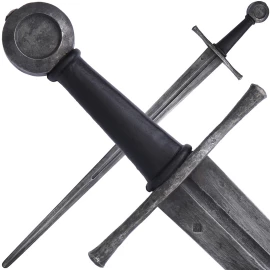
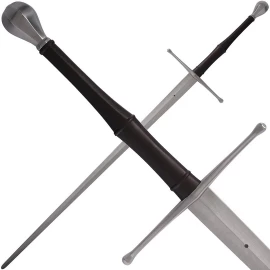
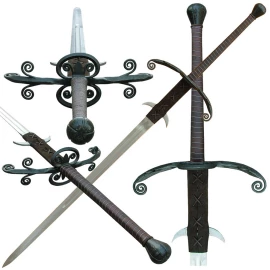
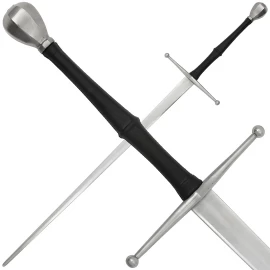
The Peter von Danzig HEMA Training Longsword is a functional practice weapon intended for modern HEMA, technical partner drills and controlled sparring with suitable protective equipment. Its spring-steel blade has a substantial 3 mm (0.12 in) blunt striking edge, a rounded safety point and a relatively stiff flex rating of approximately 16 kg (35.3 lb test load) according to the supplied specifications. At 130 cm (51.2 in) overall, with a measured weight of 1.469 kg (3.24 lb) and a point of balance 10 cm (3.9 in) forward of the crossguard, it retains full-sized longsword proportions. A decorated curved guard, leather-covered two-handed grip and distinctive faceted pommel combine practical HEMA function with late-medieval-inspired styling. Further product information ...

 Delivery options
Peter von Danzig HEMA Training Longsword
A training longsword for modern HEMA
This is neither a decorative sword nor a sharpened reproduction. It is a purpose-built training weapon for historical European martial arts. Its construction is adapted for repeated longsword practice through blunt edges, a rounded safety point and a spring blade capable of flexing during appropriate training. The supplied product information specifically identifies the sword for HEMA practice, technical drills and sparring.
Overall length is 130 cm (51.2 in), including a 100 cm (39.4 in) blade. The 22.5 cm (8.9 in) grip provides ample room for a proper two-handed hold. The measured example weighs 1.469 kg (3.24 lb) and balances 10 cm (3.9 in) forward of the crossguard. This leaves a noticeable degree of blade presence, providing useful feedback during cuts and when working in the bind.
Spring-steel blade with relatively firm flex
The blade is described as being made from spring steel and heat treated for repeated dynamic loading. The exact alloy and blade hardness are not reliably specified for this model, so we do not assign values that have not been confirmed.
The supplied specification gives a flex rating of approximately 16 kg (35.3 lb test load). This makes the blade relatively firm in character. Such stiffness can provide clear feedback in blade engagement and good point stability, but it also requires disciplined control during thrusting and suitable protection for both fencers. Before competition use, check that the blade flex and all other dimensions satisfy the rules of the particular event or organisation.
Blade width immediately below the guard is 46.9 mm (1.85 in). It narrows strongly towards the point and measures only 12 mm (0.47 in) approximately 10 cm (3.9 in) from the end. This creates a long, slender profile suited to accurate point work. A fuller approximately 38 cm (15.0 in) long runs through the stronger upper portion of the blade, visually defining the section and influencing material distribution.
The measured striking edge is 3 mm (0.12 in) thick. Under our classification it is therefore clearly a blunt training edge. This sword is not intended for cutting practice or for subsequent sharpening.
Rounded safety point
The blade terminates in a blunt, broadened and rounded safety point. This spatulated form increases the contact area and reduces the concentration of pressure compared with a narrow point during a correctly controlled thrust.
It must not, however, be treated as harmless. A sword weighing nearly 1.5 kg (3.3 lb), particularly with a relatively firm blade, can still transmit substantial energy at speed. Thrusts should always be controlled according to the exercise, the experience of the training partner and the protective equipment being worn.
Decorated hilt and full two-handed grip
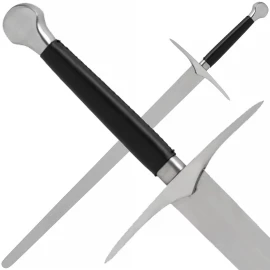
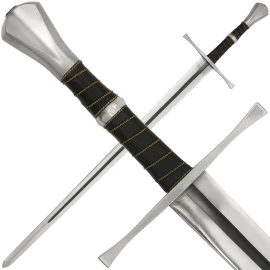
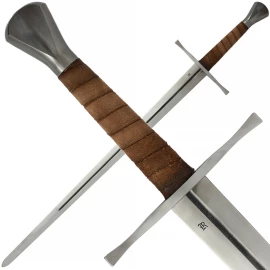
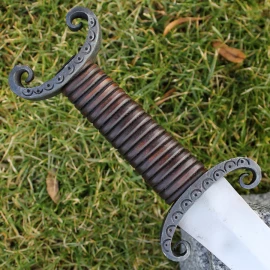
The metal crossguard measures 24 cm (9.4 in) and curves gently towards the blade. Its visible surfaces carry ornamental relief decoration, echoed in the metal pommel. Despite this more elaborate appearance, the underlying form remains practical and restrained enough for a training weapon.
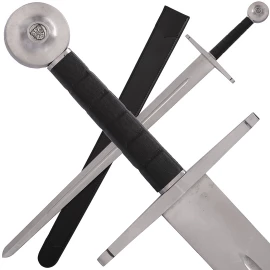
The grip is approximately 22.5 cm (8.9 in) long and covered in black leather. A subtle central profile gives both hands a useful tactile reference, particularly when fencing in substantial HEMA gloves.
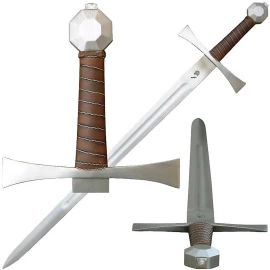
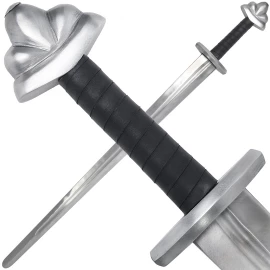
The pommel has a distinctive faceted and flared form reminiscent of certain late-medieval scent-stopper variations. On a modern HEMA sword this visual similarity should not be used as the basis for an exact historical typology. The available photographs and technical information also do not establish the precise method by which the pommel is secured to the tang, so we do not describe that construction as confirmed.
The longsword in the 15th century
The longsword was one of the important European weapons of the later Middle Ages. By the 15th century a highly developed fencing culture taught not only cuts and thrusts but also parries, counter-actions, blade engagement, changes of line and a wide range of sophisticated techniques performed with both hands.
Modern HEMA attempts to reconstruct these systems from surviving written and visual sources. Contemporary training longswords therefore commonly combine historically inspired dimensions with modern safety adaptations such as thick blunt edges, rounded points and controlled blade flex.
This Swordier is best understood as a modern functional interpretation of a late-medieval longsword, rather than an exact replica of a single surviving original. Its specialised blunt HEMA blade also makes a precise Oakeshott classification inappropriate, as that would imply a degree of historical specificity that the design does not support.
Peter von Danzig and the Liechtenauer tradition
The model name pays tribute to Peter von Danzig, a 15th-century German fencing master associated with the tradition of Johannes Liechtenauer. His name is particularly familiar to modern practitioners studying the German school of historical longsword fencing.
The manuscript tradition associated with his name forms an important part of the surviving material through which 15th-century German fencing is studied today. Liechtenauer's teachings appear within a wider environment of contemporary fencing disciplines and techniques, making Peter von Danzig an appropriate historical reference for a modern HEMA longsword.
This sword is not presented as a replica of Peter von Danzig's personal weapon, nor do we claim that he used a sword of this specific form. The model name is a tribute to his place within the historical European fencing tradition.
For HEMA sparring and technical practice
The sword is intended for practical fencing training. Depending on the experience of the fencers, protective equipment and the relevant club or competition rules, it can be used across a broad range of longsword exercises.
- HEMA longsword sparring
- technical partner drills
- practice of cutting actions and controlled thrusts
- work in the bind
- parries, counter-attacks and combinations
- solo drills and footwork
- study of 15th-century German longsword systems
The blunt blade is not intended for cutting tatami, wood, bottles or other cutting-test targets.
Technical specifications
| Specification | Value |
|---|---|
| Manufacturer | Swordier |
| Type | HEMA training longsword |
| Overall length | 130 cm (51.2 in) |
| Blade length | 100 cm (39.4 in) |
| Crossguard length | 24 cm (9.4 in) |
| Grip length | 22.5 cm (8.9 in) |
| Fuller length | 38 cm (15.0 in) |
| Blade width below guard | 46.9 mm (1.85 in) |
| Blade width 10 cm from point | 12 mm (0.47 in) |
| Striking-edge thickness | 3 mm (0.12 in) |
| Blade edge | Blunt |
| Blade point | Blunt, rounded safety point |
| Blade material | Spring steel |
| Flex rating | Approx. 16 kg (35.3 lb test load) according to supplied specification |
| Point of balance | 10 cm (3.9 in) forward of crossguard |
| Sword weight | 1.469 kg (3.24 lb) |
| Scabbard weight | 384 g (0.85 lb) |
| Belt length | 130 cm (51.2 in) |
| Belt width | 3 cm (1.18 in) |
| Belt leather thickness | 2.2 mm (0.087 in) |
| Intended use | HEMA training, technical drills and sparring |
The stated dimensions, weight and point of balance relate to the measured example. Small differences may occur between individual swords as a result of manufacturing and finishing tolerances.
Scabbard and belt
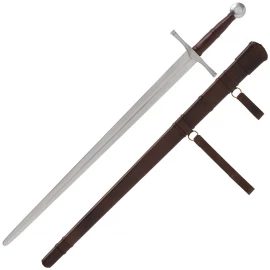
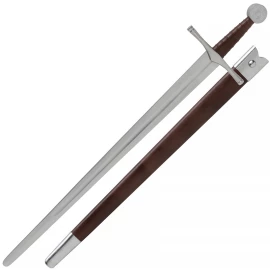
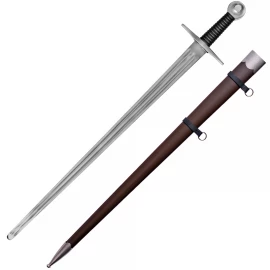
The set includes a black scabbard weighing approximately 384 g (0.85 lb). According to the supplied description, it has a rigid core with a black covering and a metal chape. Leather suspension straps allow it to be carried from the supplied belt.
The belt is approximately 130 cm (51.2 in) long and 3 cm (1.18 in) wide, with leather approximately 2.2 mm (0.087 in) thick. The scabbard is useful for transport and presentation, but a damp steel blade should never be stored inside it for an extended period.
Safety during HEMA use
A blunt training sword can still cause serious injury. Contact sparring requires complete protective equipment appropriate to the intensity of the session.
- Use a suitable fencing mask with back-of-head and throat protection.
- For sparring, wear a protective HEMA jacket, robust longsword gloves and forearm and elbow protection.
- Add chest, knee and other joint protection according to training intensity.
- Inspect the blade, point, crossguard, grip and pommel before every session.
- Remove any sharp burrs from the edges before further partner training.
- If a crack, permanent deformation or loose hilt component appears, stop using the sword until the problem has been corrected.
- A rounded point and blade flex do not replace controlled thrusting technique.
- Never train while under the influence of alcohol or other substances that impair judgement or coordination.
Care and maintenance
Wipe the spring-steel blade dry after every training session. Perspiration and moisture can encourage corrosion, so we recommend protecting the clean steel regularly with a very thin film of suitable blade oil.
After contact fencing, inspect both edges and the safety point carefully. Small burrs can damage gloves, jackets and other protective equipment and may injure a training partner. The crossguard, grip and pommel should also be checked regularly for movement or damage.
Do not strike wooden posts, stone, metal objects, concrete or other hard targets. Store the scabbard and leather belt in a dry environment and avoid prolonged exposure to high humidity or direct heat.
Recommended equipment
For contact training we recommend a good-quality HEMA mask with back-of-head protection, gorget, protective HEMA jacket, robust longsword gloves and forearm and elbow guards. Depending on training intensity, additional torso and leg protection may also be appropriate. A padded longsword bag is useful for transport, whilst suitable blade oil and a soft cleaning cloth will help with routine maintenance.
About Swordier
Swordier is associated with Longquan in Zhejiang Province, China, a region with a long tradition of sword making and metalworking. Alongside sharpened historical and fantasy-inspired swords, the brand also produces functional training weapons for contemporary HEMA.
This longsword places practical training at the centre of its design: a spring-steel blade, 3 mm (0.12 in) blunt edges, rounded safety point, two-handed grip and balance intended for systematic fencing practice. The more elaborate hilt decoration also makes it attractive to practitioners who value a stronger visual character alongside functional performance.
We are here for you!